TEXT SIZE: small | normal | large | huge In cooperation with ShipCamouflage.com The following text is not complete and contains gaps that may make it confusing until finished. I wanted to at least get the information out in public for others to read and learn from. Jump to documentation by year: "Haze Gray and underway" is a phrase that most US Navy sailors in the last sixty years will remember. The slogan has its roots in the overall haze gray they spent a significant amount of time painting their ships in. It was not always this way however, with many significant ships decked out in deep blues or so-called "dazzle" schemes not designed to hide the ship as much as its course and speed. The peacetime years between the first and second world wars was one where US Navy ships were predominately painted in a light color officially known as #5 Standard Navy Gray but more popularly as "battleship gray." Standard Navy Gray worked well for ship-to-ship engangements at long distances in the daytime, but had some disadvantages. With the advent of the aircraft carrier these lightly colored ships stood out against a dark sea and became more vulnerable to the increasingly effective strike aircraft. Additionally, #5 had a gloss and reflectance the Navy found objectionable in night time engagements as it reflected searchlight beams very well. As such, in 1935 the US Navy began to experiment with ship camouflage to determine good practices for the changing face of naval warfare. These experiments would start an explosion of camouflage that would slow down at the end of the Second World War and evevtually see a return to a single, light gray color after the end of it. But in those years camouflage was raised from merely artistic guesswork to equal parts art and science. In US Navy camouflage, there have been four types used; solid, grade, pattern, and deceptive. A solid color is used against a background and usually does well against the background it is designed for. Submarines were painted black to blend in with the night sky and sea, or deep shadows. Ships in the northern lattitudes were painted haze gray to blend in with the overcast and bad weather. Ships in the south pacific were painted a dark blue to blend in with the sea if spotted from the air. However, what works well against a deep blue sea will highlight a ship against the bright sky, and what merges a ship into the bright background of the sky will shine out like a beacon against the deep blue sea. Hence the creation of the graded schemes, which worked better in medium ranges agains both aircraft and surface craft. The bulk of the ship was camouflaged agaisnt the water by a dark hull and decks, and the superstructure would blend into the sky, making it harder for surface ships and submarines to see and identify the ship. As an added benefit, a graded scheme had some deceptive qualities as well, making a ship look farther away than it actualy was in some cases. Pattern camouflage was used mainly on amphibious craft or smaller vessels that would operate near shore and in rivers and were usually made from variations of green so that they would blend in with the pattern of the background. Early experiments with "splotch" camouflage, what is called Measure 12 Modified or Measure 12 Revised today, were more of a pattern camouflage, abeit mainly because they were not successfull as a deceptive camouflages, which is our fourth and final type. "Deceptive" camouflage was not a true camouflage, in that it did not seek to hide the ship against its background. Instead, its purpose was to make it hard for enemy forces to accurately judge type, speed, course, and distance. It was particularly designed with submarines in mind as they needed to accurately judge the speed, distance, and cource of their tagets if they hoped to strike it with a torpedo. Boldly contrasting colors such as light grays and dark blues ensured that a the scheme would work in a decent range of lighting conditions. Early in their camouflage experiments the Navy realized there was no "one best scheme" and that a variety should be made available for different regions and missions. They initially chose dark, medium, and light color camouflage plus a graded scheme with multiple colors, and finally deceptive schemes that sought to make one type of ship look like another. The Navy had also been experimenting with paint formulas, changing the prewar #5 Standard Navy Gray for a variety of colors in new types of paint. While the formulas changed during experimentation, they were aimed at specific targets in color based on the Munsell color system (based off of the 1929 book, which has different values than a modern Munsell standard). By 1940 the Navy had started on a purplish-blue range of colors using a white base mixed with different ratios of a dark tinting paste in order to get different colors. A quick description of the Munsell system blended from the June, 1942 and Setptember 1941 SHIPS-2s is as follows: The letters of the Munsell notation refer to the hue, the first number refers to the reflection factor, and the second number refers to the degree of purity of the hue, that is, the absence of gray. A light paint has a larger per cent of reflection than a dark paint. This per cent may be called the reflection factor. The reflection factor is independent of the color (hue) of the surface. The specification that a certain is "Munsell PB 5/2" means that under daylight illumination the paint matches color and brightness the colored rectangle in the Munsell Book of Color on page "Purple Blue", row 5, column 2. The results of the tests was first officially codified in a January, 1941 document titled "SHIPS-2." Released by the Bureau of Ships, SHIPS-2 was updated throughout the war with camouflage measures and paint colors that were to be used on Navy ships from the smallest lighter to the mighty capital ships. These colors and their 1929 Munsell values are included below for the correspondence that referrs to colors by Munsell rather than official Navy designation.
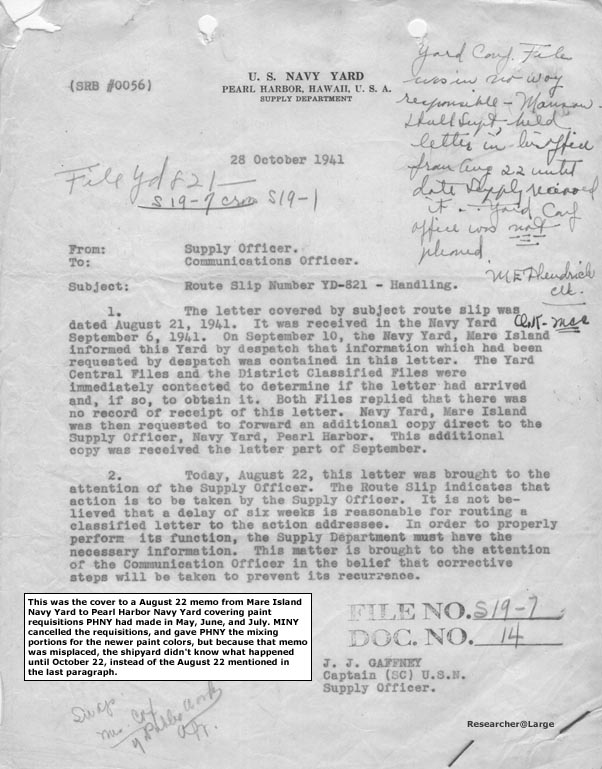
The initial experiements had settled on colors labeled "Dark Gray," "Ocean Gray," and "Light Gray." Various formulas were tried, and by early 1941 three had been chosen. Each was given a desigation starting with the number 5, denoting it was to be used on vertical surfaces, and a letter designation corresponding to the color name. 5-D was the Dark Gray, 5-O was Ocean Gray, and 5-L was Light Gray. The last two of these were designed to be mixed from two parts; a white base and a dark blue (almost black) tinting paste in different ratios, a practice the Navy expanded during the war as new colors were desired. In service, there were actually two slightly different 5-Ds that were authorized; the initial application consisted of a black tinting paste mixed with old stock of the pre-war gray versus the "official" 5-D that was completely neutral. The converted 5-D was first used on the Pacific fleet in late May of 1941 and may have stil been in use on many of the ships as the Navy decided soon after its first use to discontinue 5-D. It had been decided fairly quickly on the east coast that 5-D was unsuitable, and a new color, 5-S Sea Blue was created. 5-D was ordered discontinuted at the end of July, 1941, and the Navy paint manufacturing yards switched to 5-S in its place. But even 5-S was unacceptable, and a darker mixture, designated 5-N Navy Blue was created in the fall and tested on some ships of the East Coast fleet. 5-S continued in use in an inconsistant pattern through 1942, but for the most part ships began transitioning to 5-N in their camouflage starting in December of 1941. Both 5-S and 5-N were composed of the same white base and tinting material as 5-L and 5-O, meaning that no new supply chains were needed. In 5-N Navy Blue, the Navy found a paint color it found acceptible for both the Pacific and Atlantic theaters, and it would remain in use past the end of the war. The standard monotone and graded schemes were not viewed as effective in course and range deception. Consequently, the Navy allowed for irregular patterns to be painted on ships starting in the fall of 1941. What is now known as Measure 12 Modified or revised was described in the first revision to SHIPS-2, released to the fleet in October. No official plans were released, just a textual description of "splotches" and four small examples. This lead to a broad array of patterns, with each ship different than the next, and even ships carrying different patterns after each yard visit and upkeep. While visually striking, in service Measure 12 modified was usually not effective at breaking up a ship's outline or confusing her course. Splotch patters were generally too small and not placed with any real thought to breaking up an outline in such a way as to make identification more difficult. Consequently, as the distance from a ship increased, the splotch patterns tended to blend together and lose any distinction. The US Navy still had access to a number of the "camoufleurs" of the First World War, and efforts were started quickly to regain the knowledge lost after these teams had been disbanded at the conclusion of the war. Everett Warner was one such Camoufleur. Having been the head of the Design Section of Navy Camouflage in the First World War, he had written the Navy in April of 1941 offering his services after seeing examples of Royal Navy ships in Dazzle in use in the Mediterranean sea. At the time, the Navy declined his services, not anticipating using dazzle schemes again, but by 1943 he was at work, using a more scientific method to design effective patterns for the modern ships. This work was official codified in the dazzle patterns of the Measure 31-32-33 series in 1943. These patterns were true course deceptive schemes, not meant to hide the ship but make it difficult to gauge speed and heading; both needed to accurately aim a visually-fired torpedo. These disruptive paint schemes were ordered used on ships assigned to the Pacific starting in October of 1943. As opposed to the vague wording for Measure 12 Modified, each class of ship had one or more patterns specificaly designed and issued by way of a "design sheet" that showed both sides of the ship, deck patterns if they existed, and even sections showing front and rear faces of turets and superstructure bulkheads. Just over a year later, these dazzle schemes became a liability by making ships stand out in the ocean for attacking kamikazes. The Navy began a crash program to remove the dazzle schemes and return the ships to camouflage that was better suited for anti-aircraft and anti-ship concealment. In late 1944 memos circulated directing that Measures 21 and 22 were to be applied while new paint instructions were being developed. These instructions hit in late February, 1945 (see document S19-7 Serial 631) and were largely the same as before, however the paint formulas had now changed. In the years since the original development of the purple-blue paints, the Navy had learned that color didn't really matter at a distance, just tone. Given this and a shortage of blue pigments, the Navy dropped the purple-blue range of paints and brought out new, neutral grays with the same tone as the paints they replaced. Navy Gray, a replacement for Navy Blue, was the same darkness at a distance as its predecessor. The long supply chains and quanties od purple-blue paints meant that many ships continued using the older paints past the end of the war. In some cases a ship continued to wear a dazzle scheme past the February directive. USS Hornet CV-12, for example, maintained a very weather-beaten Measure 33 Pattern 3A until typhoon damage in June of 1945 forced her back to the United States mainland for repairs. Generally speaking, a ship receiving an overhaul at a mainland navy yard would receive the new, neutral paints, whereas ships in forward areas would repaint in stocks of the older, purple blue formulas. With the end of the war and drawdown of forces there was a need to simplify supply chains and budgets, and the Navy returned to a light gray scheme overal, the Camouflage Measure 13, using stocks of the left-over purple blue 5-H Haze Gray and neutral 5-H Haze Gray #27. There have been only minor changes since. Physical Camouflage In addition to the painting of vessels, the Navy also tried techniques to alter the physical appearance of vessels. Smaller ships and boats ocasionally used camouflage netting to hide or break up the outline of a ship against a jungle riverbank. Experiments were carried out on PT boats on and off during the war with elaborate rigs that sprayed a mixture containing carbon black on the water to decrease the visibility of the wake - some experiments reported a 90-95% reduction in visibility of the wake. Documents:
Links: Ships Home | Researcher@Large Home |